Surgery & recovery
10 Tips for a Faster Recovery After Gallbladder Stone Surgery
Diet, rest, walking, wound care and the warning signs worth a phone call — what our surgical team tells every patient before they go home.
Having your gallbladder removed is one of the most common operations performed anywhere in the world, and for most people it goes smoothly. Still, the days that follow raise a lot of questions. What can I eat? When can I go back to work? Is this much pain normal? Good gallbladder stone surgery recovery comes down to a handful of simple habits in the first two to four weeks — none of them complicated, all of them easy to forget once you are home and busy again.
Here are ten things our surgical team at Nethra Hospital, Arakkonam tells every patient before they are discharged.
How long does recovery actually take?
Nearly all gallbladder removals today are done as keyhole gallbladder surgery — three or four small cuts rather than one long one. That is why the laparoscopic cholecystectomy recovery time is so much shorter than the open operation your parents might remember. Most patients go home within 24 to 48 hours.
As a rough guide, the number of gallbladder operation rest days people need works out as:
- Days 1–3: sore, tired, moving slowly. Shoulder-tip pain from the gas used during surgery is common and settles on its own.
- Week 1: walking comfortably indoors, eating light meals, off most painkillers.
- Weeks 2–3: desk work, teaching, shop counters and most office jobs are usually possible.
- Weeks 4–6: heavy lifting, farm work, construction, gym and long two-wheeler rides.
If your surgery was open rather than keyhole, or if there were complications such as infection or stones in the bile duct, add two to four weeks to each of those. Your own surgeon’s advice always overrides a general timeline.
10 tips for a faster recovery
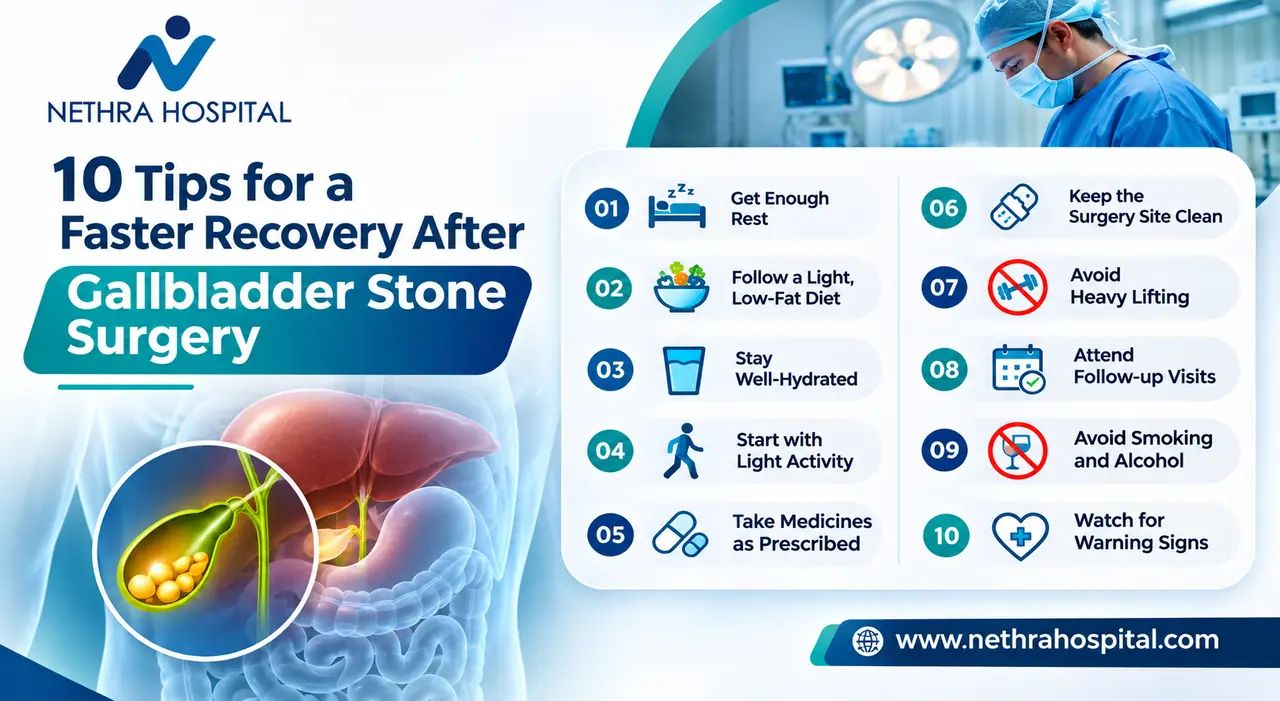
Get enough rest
Your body does its repair work while you sleep. Expect to feel unusually tired for the first week — that is the anaesthetic and the healing, not weakness. Sleep when you feel like it, and prop yourself up with an extra pillow if lying flat pulls at the wounds. Many people find the first two or three nights easier in a semi-reclined position.
Follow a light, low-fat diet
Without a gallbladder, bile drips into the intestine steadily instead of being released in a concentrated squirt when you eat fat. Large, oily meals are therefore harder to handle in the early weeks. Start with idli, rice, curd, dal, soft vegetables, bananas and clear soups. Go easy on deep-fried food, heavy coconut gravies, mutton and full-cream dairy for about a month, then add them back gradually. Smaller meals eaten more often work far better than three large ones.
Stay well-hydrated
Aim for two to three litres of water a day unless your doctor has told you to restrict fluids. Hydration keeps the bowels moving, which matters because painkillers and reduced activity both tend to cause constipation — and straining is the last thing fresh wounds need. Plain water, buttermilk, tender coconut water and thin rasam all count.
Start with light activity
Rest is not the same as bed rest. Short, gentle walks from the very first day reduce the risk of blood clots and chest infection, and help clear the trapped gas that causes shoulder pain. Begin with a few minutes indoors every couple of hours and build from there. Stop if something hurts sharply; mild pulling is normal.
Take medicines as prescribed
Finish the full course of antibiotics even after you feel well, and take painkillers on the schedule you were given rather than waiting for the pain to become severe — it is much easier to stay ahead of it. Tell the hospital about any regular medicines you take for diabetes, blood pressure, thyroid or blood thinning, since some need adjusting around surgery.
Keep the surgery site clean
Keep the dressings dry and intact until your surgeon says otherwise. Once you are cleared to bathe, let clean water run over the area, pat it dry gently, and leave it alone — no soap scrubbing, no oil, no turmeric paste or home remedies on the wound. Wear loose cotton clothing so nothing rubs against the cuts.
Avoid heavy lifting
Nothing heavier than four or five kilograms for the first four weeks. That includes water cans, gas cylinders, sacks of rice, suitcases and toddlers. Lifting too early strains the healing abdominal wall and is the main cause of a hernia at one of the keyhole sites — a problem that needs another operation to fix.
Attend follow-up visits
Your review appointment is where stitches or clips come out, the wounds are checked for infection, and the laboratory report on the removed gallbladder is discussed. It is a short visit and almost always reassuring. Please keep it even if you feel completely fine.
Avoid smoking and alcohol
Smoking narrows the small blood vessels that carry oxygen to healing tissue, which measurably slows wound healing and raises the risk of chest complications. Alcohol interacts with painkillers and antibiotics and irritates a digestive system that is already adjusting. Stay off both for at least four weeks — and if you were thinking of stopping anyway, this is the easiest window you will get.
Watch for warning signs
Most recoveries are uneventful, but a few problems need to be seen quickly rather than waited out. Contact us the same day if you notice any of the following.
- Fever above 100.4°F (38°C), or chills and shivering
- Redness, swelling, warmth or pus-like discharge from any of the wounds
- Yellowing of the eyes or skin, very dark urine, or pale, clay-coloured stools
- Severe or worsening abdominal pain that painkillers do not touch
- Repeated vomiting, or being unable to keep fluids down
- No passing of gas or stool for more than two to three days
- Breathlessness, chest pain, or pain and swelling in one calf
The short version
Walk a little, eat light, drink water, keep the wounds dry, skip the heavy lifting, and go to your follow-up. Most of our patients are back to their normal routine within two to three weeks and eating everything again within a couple of months.
If you are in Arakkonam or the surrounding towns and have been told you have gallstones — or you have had surgery elsewhere and something doesn’t feel right — our general and laparoscopic surgery team runs a daily OPD and a 24-hour emergency department.